
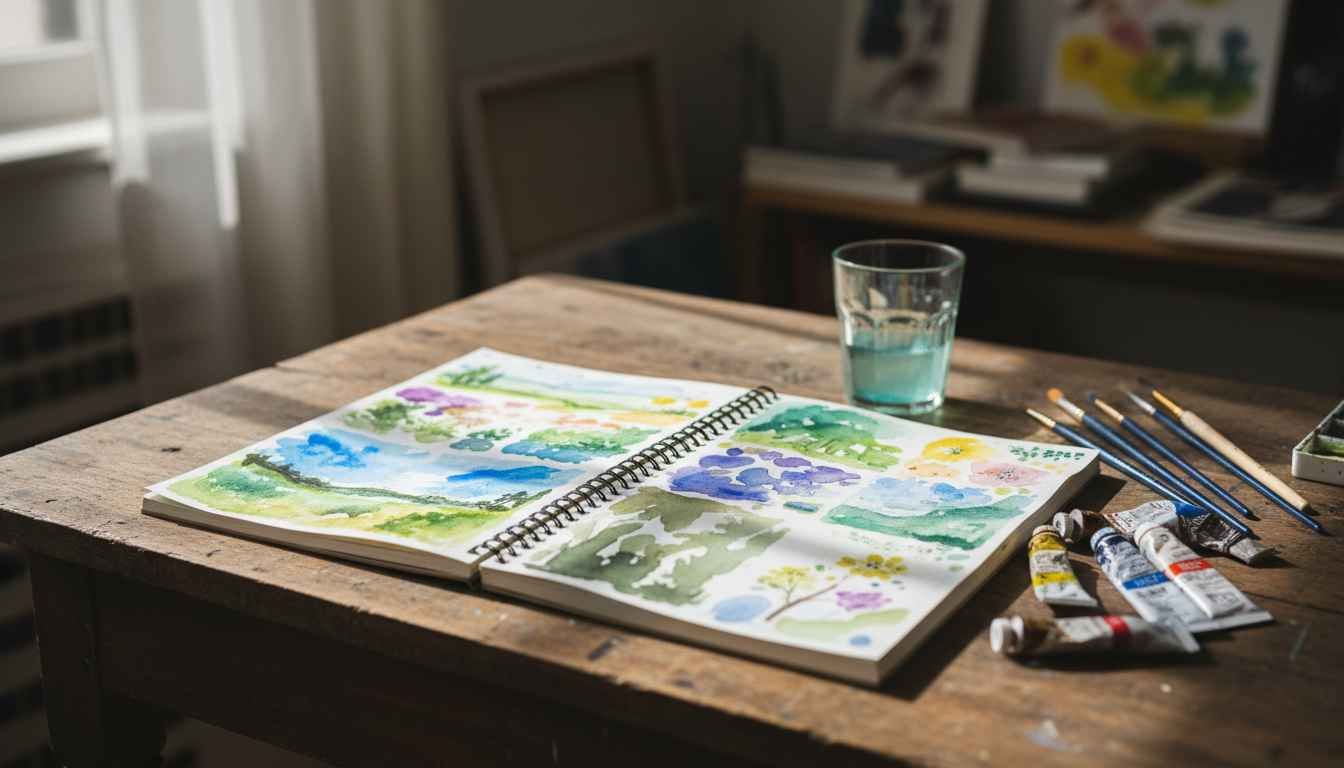
“Paint it black, paint it black, as the night consumes the day.” Creativity often begins in the shadows, where your imagination flares brightest, and for many artists, the water paint sketchbook is the portal to that inner universe.
Have you ever wondered why some sketches feel alive while others remain flat? The secret often lies not in the talent of the hand, but in the canvas itself. A water paint sketchbook transforms ordinary paper into a dynamic stage, absorbing pigment while allowing fluid manipulation of watercolors. But choosing the right one requires more than instinct; it demands understanding the delicate dance between paper, brush, and pigment.
Quiz Your Knowledge About Water Paint Sketchbooks
Question 1: What differentiates a water paint sketchbook from a regular sketchbook?
Answer: The primary difference is in the paper’s composition and weight. Water paint sketchbooks feature heavier, textured paper that can endure multiple layers of water and pigment without warping or bleeding. Typical sketchbooks designed for graphite or ink lack this resilience, causing uneven washes and frustrating results. Understanding this distinction is crucial for artists aiming to harness watercolors fully.
Question 2: How does paper weight affect watercolor performance?
Answer: Paper weight, measured in grams per square meter (gsm), determines how well the sheet handles water. Lighter papers, around 90–120 gsm, absorb paint quickly but may buckle or tear. Medium weight, 200–300 gsm, balances flexibility with durability. Heavyweight papers, 300 gsm and above, allow wet-on-wet techniques and repeated washes without compromising the page. Artists must match the paper weight to their technique for optimal results.
Question 3: Why is texture important in a water paint sketchbook?
Answer: Texture, or “tooth,” influences how paint interacts with paper. Rough textures hold pigment in the grooves, producing rich granulation, while smooth textures offer even washes and delicate blending. For experimental artists, having both textures can unlock new creative possibilities. Choosing the wrong texture can make pigments appear flat or muddy.
Question 4: Can you use any watercolor paint on these sketchbooks?
Answer: While most watercolors work on water paint sketchbooks, the quality of paint matters. Professional-grade paints with high pigment concentration will show vibrancy and layering potential, whereas student-grade paints may appear washed out on heavy paper. The synergy between high-quality paint and premium sketchbook paper elevates the artwork beyond technical skill alone.
Question 5: How do you prevent warping and buckling?
Answer: Several methods exist. Pre-stretching paper with water before painting, using heavier paper weights, or securing the sheet with masking tape can mitigate warping. Additionally, letting each layer dry completely before applying the next ensures the page maintains structural integrity. These subtle techniques separate amateur results from professional finishes.
Expert Insights: Why the Right Sketchbook Transforms Creativity
Artists often overlook the psychological impact of a superior sketchbook. The tactile pleasure of a water paint sketchbook encourages exploration and risk-taking. Knowing your medium will respond predictably reduces hesitation, freeing your mind to experiment with color, texture, and composition. This is where the magic happens: when technical reliability meets imaginative spontaneity.
Investing in a premium water paint sketchbook also signals commitment. It’s not just a notebook; it’s a dedicated space where ideas are nurtured. For instance, CLOTH & offers sketchbooks designed with this philosophy, merging luxurious textures with practical resilience for artists who seek both form and function.
Troubleshooting Common Watercolor Issues
| Problem | Solution |
|---|---|
| Paper warping | Use heavier paper (200–300 gsm) or tape edges before painting |
| Pigment bleeding | Ensure paper is designed for watercolors; apply thin washes |
| Colors appearing dull | Layer colors gradually; use high-pigment paints |
| Uneven texture effects | Match brush type and paper texture; experiment with wet-on-wet vs dry brush |
| Paper tearing | Avoid excessive water on light-weight paper; consider pre-stretching |
Potential Drawbacks or Who Should Avoid This
Despite their allure, water paint sketchbooks are not universally suitable. Artists who predominantly work in dry mediums like graphite or colored pencil may find these papers unnecessarily textured and costly. Additionally, if portability is a priority, the heavier, thicker pages can make sketchbooks cumbersome. Lastly, beginners may struggle with water control, leading to frustration; mastering the medium first may be beneficial before investing in high-end sketchbooks.
Pro Tips to Elevate Your Water Paint Sketchbook Practice
1. Experiment with both hot-pressed (smooth) and cold-pressed (textured) papers to see which complements your style.
2. Keep a small spray bottle handy to lightly mist sheets; this controls blending without over-saturating.
3. Rotate your sketchbook for unusual angles; gravity can enhance natural watercolor flows.
4. Document mistakes as part of the journey. Watercolor is inherently unpredictable, and errors often reveal innovative techniques.
5. Layer and lift strategically. Use minimal water to lift unwanted pigment gently; it preserves the texture and avoids harsh lines.
Conclusion: The Art of Choosing Your Water Paint Sketchbook
Water paint sketchbooks are more than tools – they are silent collaborators. Understanding their characteristics, from weight and texture to responsiveness, allows you to control your medium without stifling spontaneity. By approaching your sketchbook as both a canvas and a laboratory, you unlock a spectrum of creative possibilities, transforming fleeting ideas into enduring expressions. Embrace the paper, respect the water, and let your brush navigate the unknown.
